Introduction
The animation industry has transformed dramatically over the past decade. Studios no longer hire candidates simply because they have completed a course or earned a certificate. Today, employers want professionals who can solve real production challenges, work with industry-standard software, communicate within teams, and deliver quality work under deadlines. This shift has made practical animation training more valuable than ever before.
Many students still believe that spending months learning theory alone is enough to build a successful animation career. While theoretical concepts such as design principles, color theory, storytelling, and animation fundamentals are important, they only create the foundation. The real transformation happens when students start working on live assignments, production pipelines, client simulations, and portfolio projects.
This is where the difference between classroom lectures and real-world experience becomes clear. Students who receive practical animation training understand how studios function, how deadlines are managed, how feedback improves quality, and how teamwork contributes to successful projects. These experiences make them confident professionals rather than beginners.
Whether you are planning to pursue an animation course after 12th, looking for an industry-oriented animation course, or searching for an animation training institute, choosing a program that emphasizes real projects can significantly improve your career opportunities.
Why is Practical Animation Training Better Than Theoretical Learning ?
Key Takeaways
- Practical animation training prepares students for real studio environments.
- Theory builds understanding, while projects develop professional skills.
- Live assignments strengthen creativity and technical expertise.
- Portfolio projects increase placement opportunities.
- Industry-oriented training improves confidence during interviews.
- Students learn teamwork, communication, and production pipelines.
- Practical experience helps adapt quickly to studio expectations.
- Real projects create stronger resumes than theory-based coursework.
- Employers prefer candidates with practical experience and professional portfolios.
- Choosing an animation institute that focuses on projects can improve long-term career growth.
Practical Animation Training vs Theoretical Learning
Theoretical education introduces students to the concepts behind animation. It explains timing, spacing, squash and stretch, character design, storytelling, cinematography, composition, lighting, and color psychology. These concepts are essential because they help students understand why animations look believable and emotionally engaging.
However, understanding concepts alone does not prepare students for production work.
During practical animation training, students apply these concepts using professional software like Adobe Creative Suite, Autodesk Maya, Blender, Toon Boom Harmony, Unreal Engine, and other industry tools. Instead of reading about character rigging, they build rigs. Instead of studying lighting theory, they create cinematic scenes. Instead of only learning animation principles, they animate characters frame by frame.
This practical exposure develops muscle memory, creative thinking, and production confidence.
The biggest difference is that theoretical learning answers “what” and “why,” while practical training teaches “how.”
Why Real Projects Matter More
Animation studios work on deadlines, client expectations, revisions, and teamwork. These situations cannot be fully understood through textbooks.
Real projects expose students to professional challenges such as:
- Managing project timelines
- Meeting quality standards
- Working with production teams
- Accepting client feedback
- Solving technical issues
- Improving efficiency
- Following production pipelines
Students gradually become comfortable handling responsibilities similar to those in professional studios.
This is why practical animation training produces graduates who require less additional training after recruitment.
Building an Industry-Level Portfolio
One of the biggest hiring factors in animation is the portfolio.
Recruiters rarely ask candidates to explain textbook definitions. Instead, they evaluate animation reels, character designs, environments, motion graphics, VFX shots, UI designs, or game assets.
A strong portfolio demonstrates:
- Creativity
- Technical skills
- Software proficiency
- Artistic understanding
- Project execution
- Problem-solving ability
- Consistency
Students completing an animation course with projects naturally graduate with multiple portfolio pieces because every assignment contributes to their professional showcase.
This significantly increases interview opportunities.
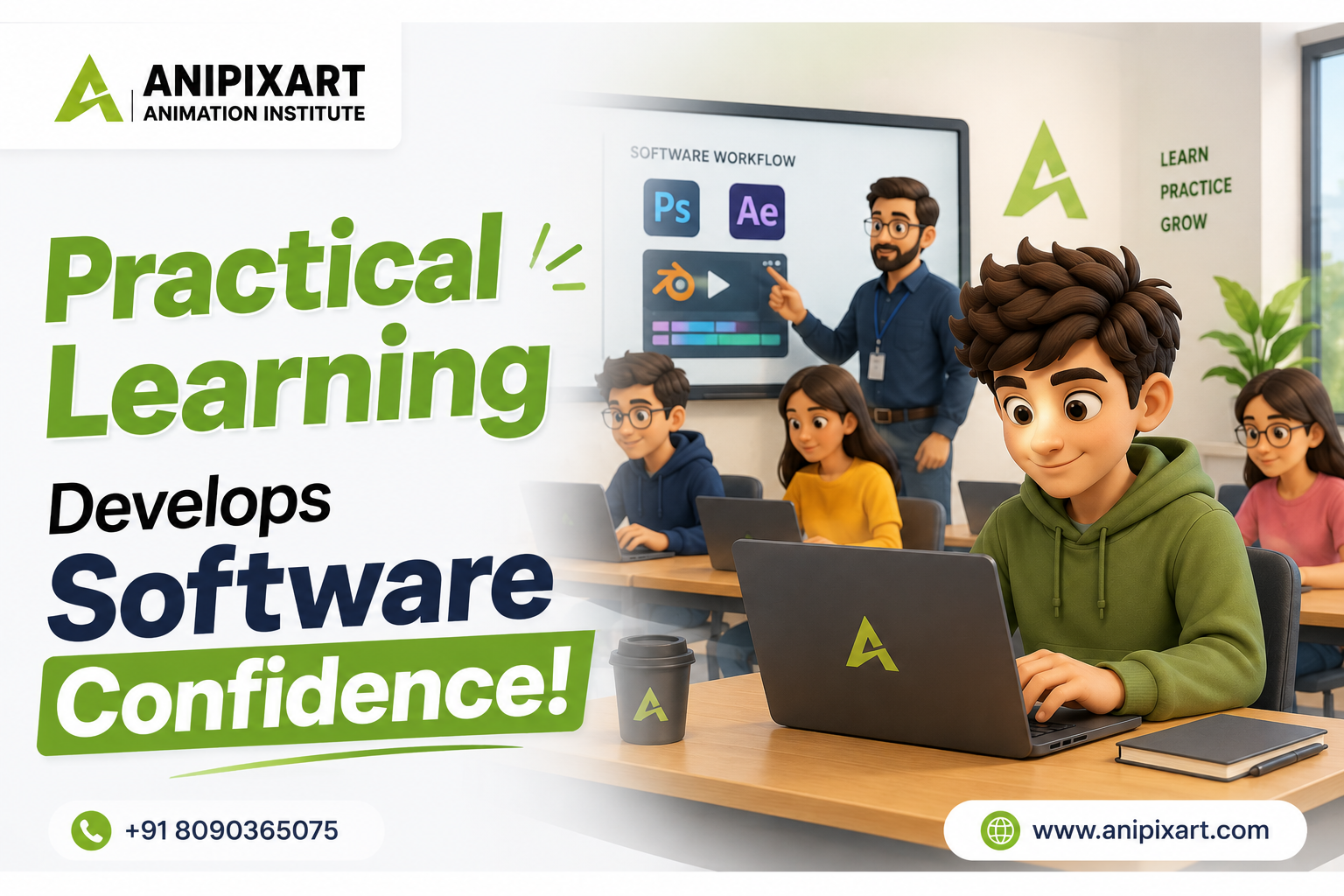
Practical Learning Develops Software Confidence
Animation software cannot be mastered by watching tutorials alone.
Students improve only through consistent practice.
Practical assignments encourage learners to:
- Model characters
- Texture environments
- Animate movements
- Create visual effects
- Edit videos
- Design graphics
- Render final outputs
- Fix production errors
Every completed project improves speed and confidence.
As software evolves continuously, practical learners also become better at adapting to new tools and AI-assisted workflows.
Learning Teamwork and Production Pipelines
Animation is rarely an individual profession.
Large productions involve:
- Concept artists
- Graphic designers
- Storyboard artists
- Modelers
- Texture artists
- Riggers
- Animators
- Lighting artists
- Compositors
- Editors
Students receiving practical animation training understand how every department contributes to the final production.
Working in teams teaches communication, accountability, collaboration, and workflow management—qualities highly appreciated by employers.
Industry-Oriented Learning Improves Employability
Employers prefer candidates who can start contributing immediately.
Students trained through real projects already understand:
- Client expectations
- File management
- Asset organization
- Production timelines
- Software pipelines
- Professional communication
- Quality control
Because of this, companies spend less time on basic training after hiring.
This makes candidates from industry-oriented animation courses more attractive during placements.
How Practical Animation Training Supports Freelancing
Practical learning benefits not only job seekers but also freelancers.
Students working on simulated client projects learn:
- Requirement gathering
- Revision management
- Pricing strategies
- Client communication
- Project delivery
- Time management
These experiences prepare them for domestic as well as international freelance opportunities.
Many successful freelancers begin their careers while still completing project-based animation courses.
Importance of Placement Support
An excellent course combines practical learning with placement assistance.
Quality institutes generally help students through:
- Resume preparation
- Portfolio development
- Demo reel creation
- Mock interviews
- Personality development
- Industry networking
- Placement drives
This combination of practical animation training and career support gives students greater confidence while entering the job market.
Choosing the Right Animation Training Institute
Before enrolling, evaluate whether the institute offers:
- Live projects
- Industry-standard software
- Experienced mentors
- Portfolio development
- Internship opportunities
- Placement assistance
- Updated curriculum
- Individual feedback
- Modern computer labs
- Career guidance
An institute focusing only on lectures may not provide sufficient exposure to professional production.
Instead, prioritize an animation training institute where learning happens through continuous practical work.
Future of Practical Animation Training
The animation industry continues to adopt AI-powered workflows, virtual production, real-time rendering, and advanced game engines.
Future professionals must be comfortable combining creativity with technology.
Practical learning allows students to experiment with modern tools while maintaining artistic quality.
As technology changes rapidly, professionals who continuously build projects remain more employable than those relying solely on theoretical knowledge.
This makes practical animation training one of the most valuable investments for aspiring creative professionals.
Course Duration
The duration of an animation course depends on specialization and career goals.
Typical course durations include:
- Short-term certificate courses: 3–6 months
- Professional diploma courses: 6–12 months
- Advanced diploma programs: 12–24 months
- Degree programs: 3–4 years
Students seeking faster employment often choose diploma or professional certification programs that emphasize practical animation training, portfolio development, and placement support.

Course Fees
Animation course fees vary depending on:
- Course duration
- Software covered
- Infrastructure
- Faculty experience
- Placement support
- Portfolio guidance
- Project exposure
Generally, fees may range from:
- ₹30,000–₹70,000 for short-term professional courses
- ₹70,000–₹2,00,000 for advanced diploma programs
- Higher for undergraduate degree programs
Rather than choosing a course based only on cost, students should evaluate the practical exposure and career outcomes offered.
Career Scope
Animation offers diverse career opportunities across multiple industries.
Popular job roles include:
- 2D Animator
- 3D Animator
- Motion Graphics Designer
- Graphic Designer
- Video Editor
- Character Artist
- Environment Artist
- Storyboard Artist
- VFX Artist
- Game Artist
- UI/UX Designer
- Multimedia Designer
- Compositor
- Lighting Artist
- Texture Artist
Industries hiring animation professionals include:
- Films
- Television
- OTT platforms
- Gaming
- Advertising
- Digital marketing agencies
- E-learning
- Architecture visualization
- Medical animation
- Product visualization
- Social media content production
Graduates with practical animation training generally adapt more quickly to these industries because they already understand professional production workflows.
Salary
Animation salaries depend on skills, portfolio quality, location, and specialization.
Approximate salary ranges in India are:
| Experience | Average Annual Salary |
|---|---|
| Fresher | ₹2.5–5 LPA |
| 2–5 Years | ₹5–9 LPA |
| Senior Professional | ₹10–18 LPA+ |
| Specialist/Lead | ₹18–30 LPA+ |
Freelancers and international remote professionals can earn significantly more depending on project complexity and client base.
Continuous learning and strong project portfolios often influence salary growth more than certificates alone.
Conclusion
The animation industry rewards skill, creativity, and execution rather than theoretical knowledge alone. While classroom concepts provide the necessary foundation, they become truly valuable only when applied through meaningful projects. Students who receive practical animation training develop stronger portfolios, better technical confidence, improved communication skills, and a deeper understanding of professional production workflows.
If you are serious about building a successful animation career, choose an animation training institute that emphasizes live projects, portfolio development, industry-standard software, placement assistance, and real production experience. Investing in practical learning today can significantly improve your employability, career growth, and long-term success in the creative industry.
FAQs
1. Why is practical animation training better than theoretical learning?
Practical animation training helps students apply concepts through real projects, build professional portfolios, improve software skills, and gain production experience that employers value.
2. Does practical animation training improve placement opportunities?
Yes. Students with strong project portfolios and hands-on experience generally perform better during interviews and placement drives.
3. What should an animation course include?
A good course should include practical projects, portfolio development, industry software, experienced mentors, placement assistance, and updated curriculum.
4. Is theory still important in animation?
Yes. Theory provides the foundation for animation principles, storytelling, composition, and design. However, practical application is essential for mastering these concepts.
5. Can I start freelancing after practical animation training?
Yes. Project-based learning prepares students for client communication, project management, revisions, and professional delivery, making freelancing more accessible.
6. Which software should animation students learn?
Common industry software includes Adobe Photoshop, Illustrator, After Effects, Premiere Pro, Autodesk Maya, Blender, Toon Boom Harmony, Unreal Engine, Substance Painter, and ZBrush, depending on specialization.
7. Is practical animation training suitable for beginners?
Absolutely. Beginners benefit greatly because they learn by creating projects from the start, making complex concepts easier to understand.
8. How do employers evaluate animation candidates?
Most employers assess portfolios, demo reels, creativity, technical skills, software proficiency, and project quality rather than theoretical knowledge alone.
Anipixart Animation Institute
Address- Alkapuri Tiraha, C-28, Sector C, Ekta Vihar, Sector CS, Aliganj, Lucknow, Uttar Pradesh 226024 (location on google)
Phone number- +91 8090365075 or +91 9519910609
Website- www.anipixart.com
OUR GALLERY