
Introduction
Artificial Intelligence is changing the way people create, design, edit, animate and communicate ideas. From generating images and videos to helping with brainstorming, editing and design concepts, AI has become a useful part of modern creative workflows. This has also raised an important question: what does the future hold for designers, animators, video editors, digital marketers and other creative professionals?
The growth of AI in creative careers does not simply mean that humans will stop being creative. Instead, the relationship between technology and creativity is evolving. AI can automate repetitive tasks, generate multiple ideas quickly and speed up production, while humans continue to contribute imagination, emotional understanding, decision-making, storytelling and creative direction.
For students and professionals planning a creative career, understanding how to work with AI may become just as important as learning traditional creative skills.
What Is AI in Creative Careers?
AI in creative careers refers to the use of artificial intelligence tools to support different stages of creative work. These tools can help professionals generate ideas, create visual concepts, edit media, write content, analyse audiences and automate repetitive production tasks.
AI is already being used across several creative industries, including:
- Graphic design
- UI/UX design
- Animation
- VFX
- Video editing
- Digital marketing
- Gaming
- Photography
- Motion graphics
- Content creation
- 3D design
For example, a designer can use AI to create initial concepts, a video editor can speed up certain editing tasks, and a digital marketer can use AI to generate content ideas or analyse campaign data.
The important point is that AI is becoming part of the creative workflow rather than existing completely separately from it.
How Is AI Changing Creative Careers?
The impact of AI can be seen in almost every stage of the creative process.
1. Faster Idea Generation
One of the biggest advantages of AI is speed. Creative professionals can use AI to explore several concepts in a short period of time.
Instead of spending hours developing every initial idea manually, a designer can experiment with different layouts, styles, references and visual directions before developing the strongest concept.
2. Automation of Repetitive Tasks
Creative professionals often spend time on repetitive work such as background removal, resizing, colour adjustments, basic editing, asset organisation and other production activities.
AI-powered tools can automate or accelerate many of these tasks. This allows professionals to spend more time on creative decisions and problem-solving.
3. Faster Content Production
Brands increasingly need graphics, videos, social media posts, advertisements and other digital content. AI can help creative teams handle larger volumes of work within shorter timelines.
Adobe’s 2026 research found that creative professional job postings in its US comparison increased 8% between September 2025 and April 2026, while the share of postings explicitly listing AI skills increased from 10% to 15%. Adobe interpreted its findings as a redistribution of creative work rather than a straightforward replacement of creative workers.
4. More Accessible Creative Tools
AI has lowered some barriers to experimentation. People with limited technical experience can now explore concepts, generate drafts and understand creative possibilities more easily.
However, accessibility does not automatically equal professional-quality work. Understanding design principles, composition, typography, storytelling, audience behaviour and visual communication remains important.
AI vs Human Creativity: What Is the Difference?
AI and human creativity work differently.
AI can process large amounts of information, recognise patterns and generate outputs based on its training and instructions. Humans bring personal experiences, emotions, cultural understanding, intuition, judgement and individual perspectives.
Consider a simple example.
A company wants to launch a campaign for a young audience. AI may generate dozens of campaign concepts within minutes. However, a human creative professional needs to decide which idea fits the brand, audience, message, cultural context and business objective.
The difference is not simply about who can produce more ideas. It is also about which ideas are meaningful and appropriate.
AI Creativity
AI is particularly useful for:
- Rapid idea generation
- Visual experimentation
- Content variations
- Image generation
- Basic editing
- Research assistance
- Pattern recognition
- Repetitive production tasks
- Workflow automation
Human Creativity
Humans remain essential for:
- Original creative direction
- Emotional storytelling
- Strategic thinking
- Brand understanding
- Cultural context
- Client communication
- Critical thinking
- Ethical judgement
- Taste and creative judgement
- Understanding human emotions
The strongest creative workflow can therefore combine both.
Will AI Replace Designers?
This is one of the most common questions surrounding AI in creative careers.
The answer depends on what is meant by “replace.”
AI can automate or accelerate certain design tasks, especially repetitive or production-focused work. However, professional design involves much more than producing an image.
A designer needs to understand the purpose behind a project, identify the target audience, communicate a message visually, maintain brand consistency and make decisions based on context.
The World Economic Forum’s Future of Jobs Report 2025 identifies graphic designers among roles being reshaped by generative AI, while also highlighting the continuing importance of human-centred skills such as creative thinking, analytical thinking, resilience and collaboration. The report also notes that design and user-experience skills are expected to see growth linked to technological change.
This suggests that the role of designers may evolve rather than simply disappear.
Future designers may increasingly work as creative directors, problem-solvers, brand thinkers and AI-assisted visual communicators.
Which Creative Skills Will Become More Important?
As AI handles more production tasks, human skills can become even more valuable.
Creative Thinking
Professionals need to generate ideas that are relevant, distinctive and connected to a real objective.
Storytelling
A visually attractive image is not always an effective communication tool. Creative professionals need to know how to build a message and tell a story.
Problem-Solving
Clients rarely approach designers simply because they want an image. They usually have a communication, marketing or business problem.
Communication
Understanding a client’s requirements and explaining creative decisions are important professional skills.
Adaptability
Creative technology changes rapidly. Professionals who continue learning can adapt to new tools and workflows.
AI Literacy
Knowing how to use AI tools effectively can become an additional professional skill. The goal is not simply to generate content but to understand how AI can improve the creative process.
How AI Can Create New Opportunities for Creative Professionals
AI can also expand creative opportunities.
A single professional may be able to experiment with more concepts, produce prototypes faster and manage more stages of a project.
For freelancers and small creative teams, this can make certain workflows more efficient.
AI can also create demand for professionals who understand both creativity and technology. Examples include:
- AI-assisted graphic designers
- AI content creators
- Creative AI specialists
- Motion graphics artists using AI tools
- AI-assisted video editors
- AI-focused digital marketers
- Creative technologists
- AI-enhanced UI/UX designers
- 3D artists using generative workflows
Adobe’s 2026 research found that many creative professionals are integrating AI into specific parts of their workflows, particularly brainstorming, creation and production.
What Is the Future of AI in Creative Careers?
The future is likely to involve closer collaboration between humans and AI.
Instead of treating AI as a complete replacement for creative professionals, businesses can use it as a productivity and ideation tool. Professionals who know how to direct, evaluate and refine AI-generated outputs can potentially combine speed with human judgement.
The World Economic Forum also highlights human-machine collaboration and the need for reskilling and upskilling as important parts of workforce transformation.
This means future creative professionals may need two categories of skills:
Creative skills: design, animation, storytelling, editing, visual communication and problem-solving.
Technology skills: AI tools, digital workflows, automation, prompting and emerging creative software.
The combination can make a creative professional more adaptable to changing industry requirements.
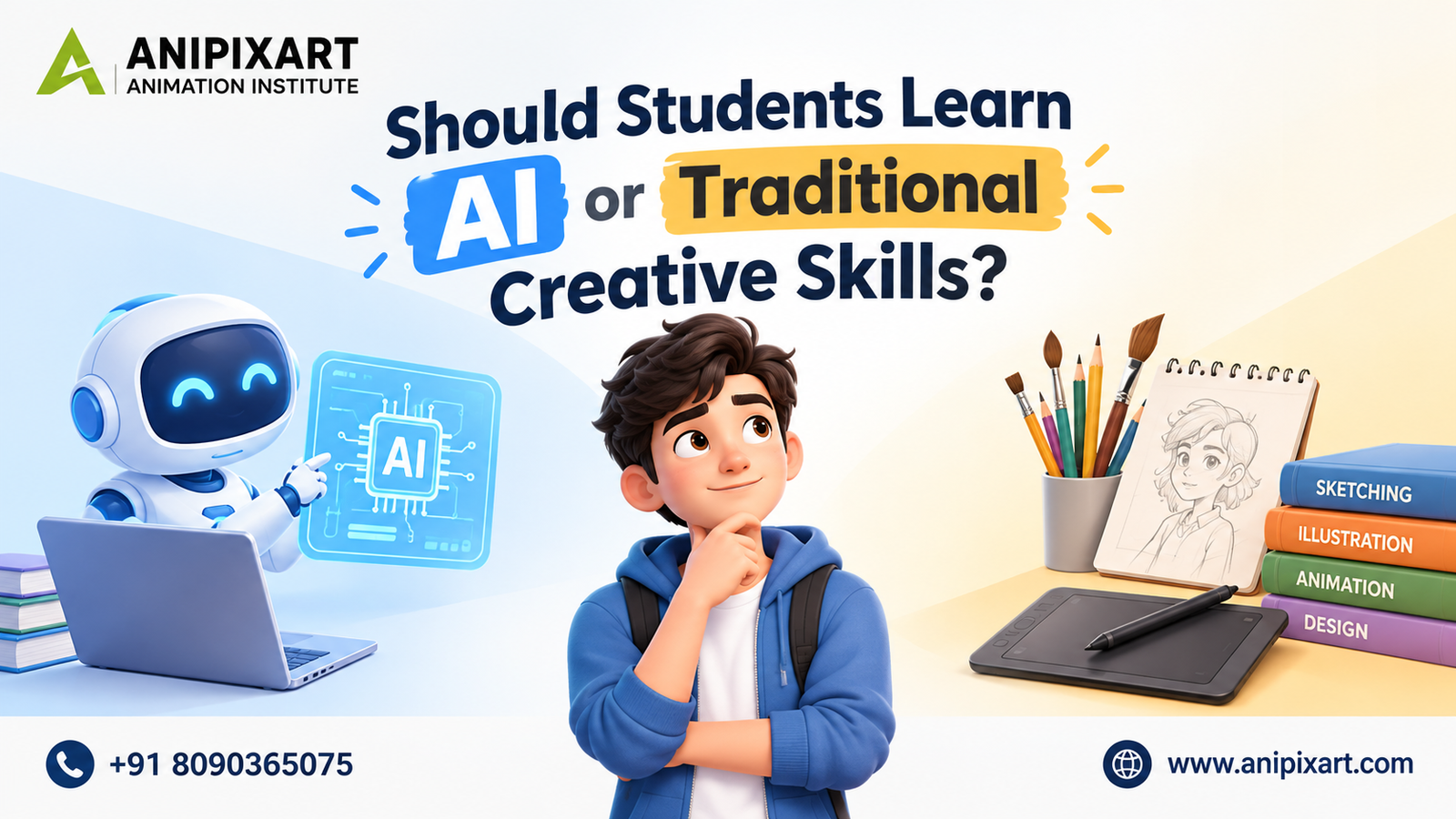
Should Students Learn AI or Traditional Creative Skills?
Students should not necessarily choose between AI and traditional creative education.
Learning the fundamentals first can make AI tools more useful.
For example, a student who understands typography can evaluate AI-generated layouts more effectively. A student who understands animation principles can use AI-assisted animation tools with better judgement. A video editor who understands storytelling can use AI tools without allowing automation to control the entire creative direction.
A strong learning approach can therefore include:
- Learn creative fundamentals.
- Practise using professional software.
- Develop real projects.
- Learn relevant AI tools.
- Build a portfolio.
- Understand industry workflows.
- Continue updating skills.
How Can Creative Professionals Stay Relevant in the AI Era?
Creative professionals can prepare for the changing industry by continuously improving their skills.
Build a Strong Portfolio
A portfolio should demonstrate problem-solving, creativity and practical project experience rather than simply showing software exercises.
Learn AI-Assisted Workflows
Understand where AI can save time and where human judgement is still required.
Develop Multiple Skills
Combining skills such as graphic design, UI/UX, video editing, motion graphics, animation or digital marketing can create broader career opportunities.
Focus on Originality
As AI-generated content becomes easier to produce, distinctive creative thinking and a recognisable style can become increasingly valuable.
Keep Learning
Creative technology will continue changing. Professionals who stop learning may find it harder to adapt to new workflows.
Why Learn Creative Skills at Anipixart Animation Institute?
For students in Lucknow looking to build a career in creative industries, learning both creative fundamentals and modern technology can provide a practical foundation.
Anipixart Animation Institute offers training across areas such as animation, VFX, gaming, UI/UX design, graphic design, video editing, motion graphics and digital marketing.
Students can work on practical projects, develop portfolios and receive guidance related to freelancing and career opportunities.
The goal of creative education in the AI era should not be to teach students how to compete against machines. It should be to help them understand how technology can become another tool in their creative workflow.
Conclusion
The future of creative careers is not simply about AI versus humans. It is increasingly about how humans and AI can work together.
AI can generate ideas, automate repetitive tasks and accelerate production, but creative professionals bring context, emotion, strategy, judgement and human perspective to the process.
For students and professionals, the most practical approach is to build strong creative fundamentals while learning how modern AI tools can support those skills.
The rise of AI in creative careers makes continuous learning more important than ever. People who combine creativity, technology and adaptability can prepare themselves for a creative industry that is changing rapidly.
If you are looking to build practical skills in animation, VFX, gaming, UI/UX, graphic design, video editing, motion graphics, digital marketing or AI, explore career-oriented courses at Anipixart Animation Institute, Lucknow.
Start learning. Keep creating. Stay ready for the future.
FAQs
1. What is AI in creative careers?
AI in creative careers means using artificial intelligence to support tasks such as ideation, design, editing, content creation, animation, marketing and production.
2. Will AI replace designers?
AI may automate certain design tasks, but professional design also involves strategy, communication, creativity, audience understanding and human judgement. The role of designers is likely to continue evolving alongside AI.
3. Is AI good for creative professionals?
AI can help creative professionals generate ideas faster, automate repetitive tasks and explore more creative possibilities. Its effectiveness depends on how thoughtfully it is integrated into the workflow.
4. Should designers learn AI?
Learning relevant AI tools can help designers adapt to changing workflows and improve productivity while continuing to develop core design skills.
5. What creative careers are affected by AI?
Graphic design, video editing, animation, digital marketing, UI/UX, content creation, photography and other digital creative fields are being influenced by AI.
6. Can AI be creative like humans?
AI can generate creative-looking outputs by recognising patterns and producing new combinations, but human creativity also involves experiences, emotions, intentions, judgement and cultural context.
7. What skills will creative professionals need in the future?
Creative thinking, problem-solving, storytelling, communication, adaptability, design fundamentals and AI literacy are likely to remain valuable.
8. Is creative education still useful because of AI?
Yes. Understanding creative fundamentals can help professionals use AI more effectively, evaluate outputs and make stronger creative decisions.
Anipixart Animation Institute
Contact number- +91 8090365075 or +91 9519910609
Website- www.anipixart.com
